Every position in the NFL faces unique challenges, but few are more complicated than the dynamic between a wide receiver and his quarterback. Former Pro Bowl wide receiver Adam Thielen recently discussed what it’s really like to play with a backup quarterback, offering a unique look at the tactical and mental adjustments veterans must make when the signal-caller changes. His comments, which were featured on NFL GameDay Morning, are far more than soundbites from the media; they capture the essence of what aids or hinders an offence while its starting quarterback is sidelined
Backup QBs Are a Different Ballgame
Teams must deal with a new reality when a starting quarterback sustains an injury, as has happened multiple times in the NFL this season: the phone-in signal-caller is now the one tossing the ball. As someone who prospered with unusual starters and adapted when the name beneath centres wasn’t familiar, Thielen summed it up this way: playing with a backup is all about communication and adaptability.

He noted that receivers must read trends more quickly than usual, anticipate timing, and align expectations. The synergy on timing routes, double moves, and contested celebrations takes time to develop, and backups frequently lack the same offensive awareness as starters. The experience of a veteran is crucial in this situation.
The Mental Shift: Patience Over Precision
In the end, the NFL is a rhythmic game. Starting quarterbacks develop a rhythm that boosts offensive confidence with their practiced cadence and trust with receivers. That beat shifts when the backup takes over. According to Thielen, receivers must adopt a more moment-to-moment strategy instead of depending solely on innate timing. This involves anticipating a change in tempo, deciding whether to trust balls that may arrive late or early, continually modifying routes dependent on the comfort level of the quarterback.
This mental shift is most apparent in high-stakes games, such as championship or playoff games, where the pressure on receivers and quarterbacks is at its highest. That pressure doesn’t go away when you account for a backup; rather than it becomes a test of flexibility.
The Significance of Experience
The fact that receivers with years of NFL experience are extremely beneficial when partnered with a backup quarterback is one of the most important lessons to be learnt from Thielen’s analysis. They are excellent at reading defences, have seen a variety of quarterback styles, and are able to pick out weaker places in coverage when the quarterback may not have great timing.
Experts like Thielen frequently act as a balancing influence in the huddle, helping rookie quarterbacks analyse coverages prior to the ball being snapped, directing them where to go with the ball, and making last-minute route changes. This leadership may be the difference between a crucial first down and a halted drive.
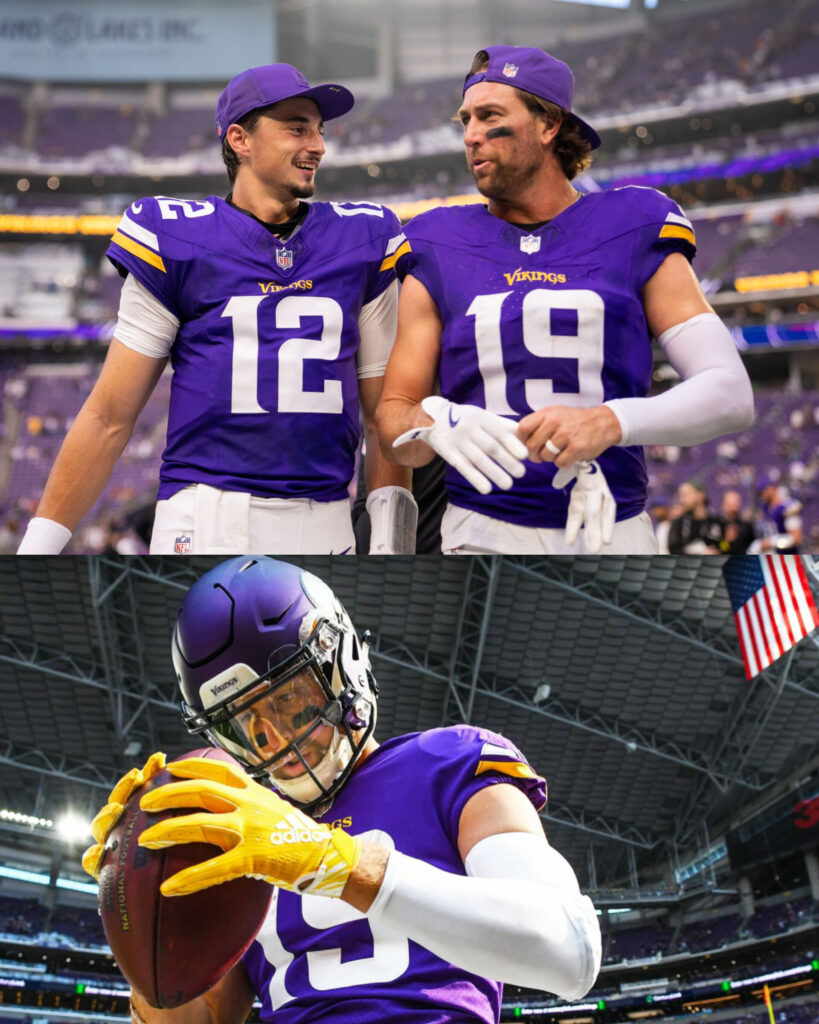
The Strategic Aspect: Practice and The Strategic Aspect: Practice and Playbooks
It involves almost simply on-field performance.
Thielen’s own career serves as a superb instance of mobility. He entered the NFL through perseverance and hard work after going undrafted from college, demonstrating early in his career that quick learning and adaptability are not only important but also essential. “Take what the defence gives you” has always been his motto as a receiver, and it also applies to reacting to quarterback play.
The Strategic Aspect: Practice and Playbooks
Coaches frequently simplify game plans when a backup takes over, relying more on quick options and high-percentage throws than on riskier deep shots, especially if the replacement hasn’t had many first-team reps. This means that receivers must modify their presumption about target kind and loudness.